
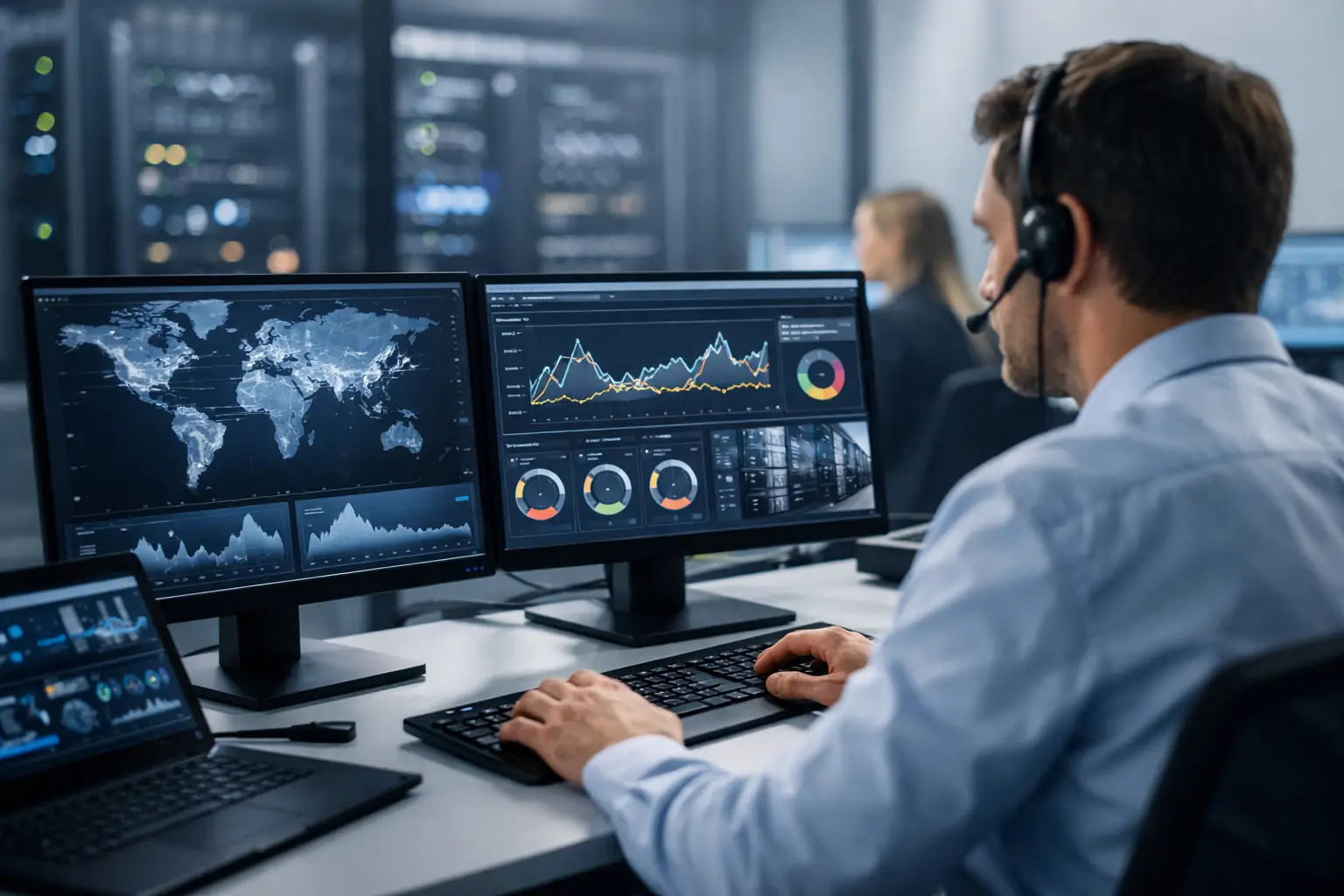
A slow application at 9:15 a.m. can quickly become a missed sales opportunity, an unproductive team, or a delayed customer response. For organizations that depend on cloud platforms, branch connectivity, Microsoft 365, and always-available systems, network monitoring services for business provide the visibility needed to find problems before they become disruptive outages.
The issue is rarely just the internet connection. A firewall may be under pressure, a switch port may be failing, a critical server may be running out of storage, or a remote site may be experiencing unusual latency. Without continuous oversight, these warning signs are easy to miss until employees, customers, or leadership report that work has stopped.
Why Network Visibility Is a Business Requirement
Networks now carry far more than email and file sharing. They connect cloud applications, VoIP phones, security cameras, payment systems, remote users, backup processes, and business-critical databases. When performance declines, the impact can spread across departments quickly.
Reactive IT support has a place when urgent incidents occur, but it is an expensive way to run a business. By the time a user raises a ticket, the issue may have already affected multiple people and interrupted an important process. Monitoring changes that model by detecting conditions such as device failure, high bandwidth consumption, connectivity loss, and unusual traffic patterns while there is still time to act.
For UAE organizations with distributed teams, warehouses, retail locations, or remote staff, this visibility is particularly valuable. A brief issue at one site can affect central operations, customer service, or access to cloud-hosted systems. The goal is not merely to keep devices online. It is to keep the business operating predictably.
What Network Monitoring Services for Business Should Cover
Effective monitoring is more than a dashboard that shows whether a router responds to a ping. A managed service should build a clear picture of the health, performance, and security of the environment, then connect alerts to a defined response process.
At a practical level, monitoring should cover the infrastructure employees and applications rely on every day. This commonly includes firewalls, routers, switches, wireless access points, servers, workstations, internet links, VPN connections, and cloud service availability. The exact scope depends on the organization, but blind spots create risk. Monitoring only the firewall, for example, may not reveal a failed switch, a degraded Wi-Fi network, or a server that is approaching capacity.
A capable provider will also establish meaningful thresholds. Not every alert deserves an emergency response. A device temporarily reaching moderate CPU use may be normal, while repeated high utilization during business hours may indicate a capacity issue, faulty configuration, or security concern. Alert tuning matters because excessive noise can cause real warnings to be overlooked.
The most useful service combines several capabilities:
- Continuous availability and performance monitoring for critical devices and connections
- Automated alerts for failures, capacity concerns, packet loss, and unusual behavior
- Event correlation to identify the likely source rather than treating every symptom separately
- Remote troubleshooting and escalation for issues that require onsite support
- Regular reporting that shows trends, recurring incidents, and infrastructure risks
From Alerts to Action: The Difference That Matters
Many businesses already receive alerts from their internet provider, firewall, or cloud platform. That does not necessarily mean they have monitoring that protects operations. Alerts have limited value if nobody owns them outside business hours, understands what they mean, or has the authority to act.
A managed monitoring service should include clear accountability. When a critical device goes offline, the provider verifies the issue, investigates the cause, and follows an agreed escalation path. If the incident affects a carrier, hardware vendor, or cloud provider, the IT partner should coordinate the case rather than leaving internal staff to manage several support desks during an outage.
Response expectations should also be defined. A provider that offers 24/7 emergency support and a 15-minute response commitment can help reduce the time between detection and intervention. That distinction is important for organizations where delayed access to systems can affect revenue, logistics, client commitments, or regulatory responsibilities.
Monitoring Supports Security, Not Just Uptime
Network performance and cybersecurity are closely connected. Sudden traffic spikes, repeated failed connections, unexpected device activity, or unusual outbound data transfers can be operational symptoms, but they can also indicate a security event.
Monitoring does not replace endpoint protection, email security, vulnerability management, or a formal incident response plan. It does, however, provide another layer of visibility. When network monitoring is aligned with cybersecurity controls, IT teams can investigate anomalies faster and determine whether an issue is caused by a hardware fault, poor configuration, user behavior, or a potential attack.
This is especially relevant where employees use remote access, cloud services, and personal networks. VPN capacity, authentication services, and internet performance can all affect remote work. Monitoring these dependencies helps an organization distinguish between a local user issue and a wider service failure.
The Business Value of Trend Reporting
The immediate benefit of monitoring is faster detection. The longer-term benefit is better planning. Monthly or quarterly reports can reveal whether an internet circuit is routinely reaching capacity, whether a server is consuming storage faster than expected, or whether an aging switch is generating repeated errors.
This information gives leadership a stronger basis for technology decisions. Instead of replacing equipment only after it fails, the organization can budget for upgrades based on measurable demand and risk. Instead of assuming a branch office needs more bandwidth, IT can review actual traffic patterns and identify the applications driving usage.
Reports should be understandable to both technical and business stakeholders. An IT manager may need device-level information and incident timelines. A finance or operations leader needs a clearer view of service availability, recurring risks, actions taken, and upcoming investment priorities. Good reporting turns technical data into operational accountability.
Choosing the Right Monitoring Model
The right approach depends on the size and complexity of the environment. A small office with a few critical cloud applications may need focused monitoring of its firewall, internet connection, Wi-Fi, endpoints, and backup status. A larger organization may require coverage across multiple locations, network segments, servers, cloud workloads, and security systems.
There is also a decision between internal ownership and a managed service. Internal teams may have strong knowledge of the business environment, but they can be stretched by projects, user requests, and after-hours responsibilities. A managed partner can extend coverage and provide specialist tools, documented processes, and escalation support. The strongest model is often collaborative: internal IT retains strategic control while the service provider handles continuous monitoring and operational response.
When evaluating a provider, ask how alerts are prioritized, who responds after hours, what systems are included, and how recurring issues are reported. It is also reasonable to ask how quickly the provider acknowledges an incident and whether they coordinate with telecom carriers, software vendors, and hardware suppliers when needed.
Building a More Resilient IT Environment
Network monitoring works best as part of a broader resilience strategy. Backup and disaster recovery protect data when systems fail. Patch management reduces exposure to known vulnerabilities. Endpoint management keeps user devices under control. Cybersecurity tools help detect and contain threats. Monitoring connects these elements by showing whether the underlying infrastructure is functioning as expected.
FixIT Computer Technologies supports organizations across the UAE with managed IT, cybersecurity, cloud, and continuity services designed around this connected view of operations. With 18+ years of regional experience, the focus is not simply on resolving the current alert, but on reducing the conditions that create repeat disruptions.
The most valuable monitoring service is one employees rarely notice because issues are handled before they affect the workday. When technology is watched, maintained, and supported with clear accountability, leaders can spend less time asking why systems failed and more time moving the business forward.